
Since the 18th National Congress of the Communist Party of China, the importance of ecological civilization has been elevated to an unprecedented height. However, projects related to ecological civilization construction face the problem of "devoting tremendous efforts with meager gains". For a long time, ecological environment governance has relied on government investment, failing to give full play to the role of market mechanisms[1].
Driven by both the era background of ecological civilization construction and the practical demand for addressing the shortage of funding for ecological environment restoration, the Eco-environment Oriented Development (EOD) model came into being. According to the Notice on Recommending Pilot Projects of the Eco-environment Oriented Development Model, jointly issued by the Ministry of Ecology and Environment, the National Development and Reform Commission, and the China Development Bank in September 2020, the EOD model is defined as "an innovative project organization and implementation method. Guided by the thought on ecological civilization and aiming at sustainable development, it is based on ecological protection and environmental governance, supported by characteristic industry operation, and carried by regional comprehensive development. By adopting approaches such as industrial chain extension, joint operation and combined development, it effectively integrates ecological environment governance projects with strong public welfare but poor profitability with associated industries with sound returns, promotes them in a coordinated way and implements them in an integrated manner, thus internalizing the economic value generated by ecological environment governance"[2].
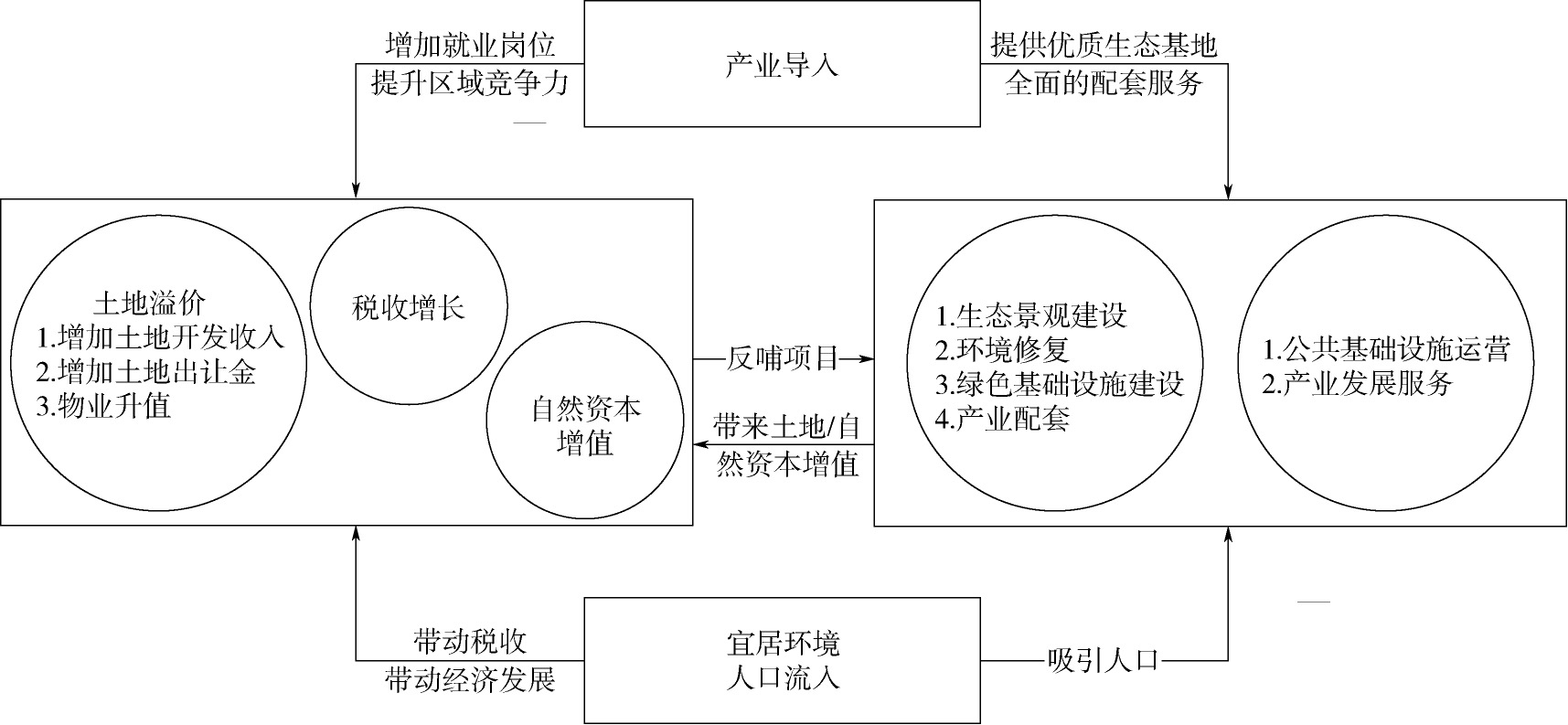
Figure 1 Analytical Diagram of the EOD Model[3]
The core essence of this model is to regard ecological environment governance as an input factor of development projects, lock in advance the benefits brought by ecological environment protection, and convert them into feedback for investment in ecological environment governance projects. In this way, it reduces the government’s financial input in public welfare-oriented ecological environment governance projects and promotes the development of such projects[4].
1. Three Stages of EOD Project Development in China
The development of EOD projects in China has mainly gone through three phases:
-
Emergence Phase (2018–2020). In 2018, the Ministry of Ecology and Environment issued Document No. 86, Guiding Opinions on Further Deepening the Reform of "Streamlining Administration, Delegating Power, Improving Regulation and Optimizing Services" in the Field of Ecology and Environment to Promote High-Quality Economic Development, which proposed exploring the Eco-environment Oriented Development (EOD) model for urban development. This marked the first official introduction of the EOD model to the public.
-
Exploration and Practice Phase (2020–2022). During this period, the General Office of the Ministry of Ecology and Environment, the General Office of the National Development and Reform Commission, and the General Office of the China Development Bank jointly launched the recommendation of the first and second batches of national EOD pilot projects, selecting a total of 94 regional projects for piloting.
-
Regular Advancement Phase (2023–Present). With the issuance of the Guidelines for the Inclusion of Eco-environmental Protection Projects Supported by Finance into the Project Reserve Repository (Trial)[5] and the Implementation Guidelines for Eco-environment Oriented Development (EOD) Projects (Trial) (hereinafter referred to as the Guidelines)[6], various provinces and cities have gradually established their own EOD pilots and project repositories, marking the entry of EOD projects into a phase of regular advancement. Data shows that as of the end of September 2023, 205 EOD projects have been included in the Eco-environmental Protection Finance-Supported Project Reserve Repository and recommended to financial institutions, with a total investment of 921.3 billion yuan and a financing demand of 643.9 billion yuan. At present, 77 projects have obtained support from financial institutions[7].
2. The Driving Logic of EOD Projects Has Shifted from Solving Pollution Problems to Realizing the Value of Ecological Products
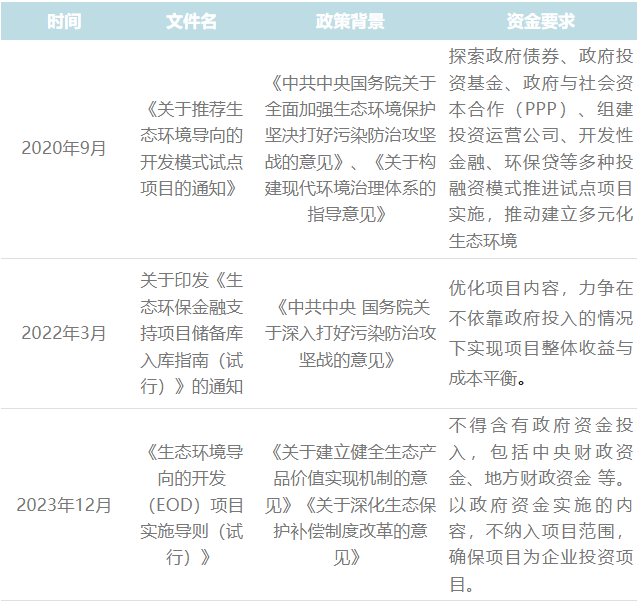
As shown in Table 1, an analysis of the relevant documents on EOD projects issued in different periods reveals two notable changes. First, the policy background of EOD projects has undergone a distinct shift—from fighting the tough battle of pollution prevention and control to establishing and improving the mechanism for realizing the value of ecological products. In addition, in terms of government funding requirements for EOD projects, the model has gradually evolved from the exploration phase’s diversified investment and financing models that included government funds to a model where government funding input is not permitted. The above changes indicate that the underlying driving logic of EOD projects has transformed from solving pollution problems to realizing the value of ecological products.
3. How Do EOD Projects Promote the Realization of Ecological Product Value?
Accurate identification of environmental issues is the foundation for developing ecological products. The premise of realizing the value of ecological products lies in creating effective ecological products. Therefore, the Guidelines set higher requirements for identifying specific environmental problems and defining targeted project objectives. Particularly in the section on environmental goal setting, it stipulates that "ecological environment quality improvement goals should be mainly quantitative, with specific and non-generalized indicators. Regional ecological, environmental, social, and economic development goals shall not replace the project’s own objectives. Project indicators must be consistent with actual conditions and achievable through project implementation." Additionally, the ecological environment governance content must meet the criteria of public welfare, accuracy, relevance, feasibility, and certainty.
-
Public Welfare: In wording, it requires the ecological environment governance content to fall within the scope of government responsibilities; in essence, it needs to reflect the public attribute of ecological products. For example, non-public welfare ecological environment governance content within enterprises’ responsibilities—such as mine governance, soil and groundwater pollution risk control and remediation, and "three synchronizations" environmental protection facilities—no longer meets the requirements.
-
Accuracy: It requires viewing ecological products from the perspective of ecosystem services. For instance, projects such as water system connectivity solely for water transfer and utilization, or river dredging, flood control dikes, slope maintenance, landslide control, and landscape greening, are not included because they cannot substantially enhance ecosystem service capabilities.
Linked industrial operation is the form through which the value of ecological products is realized. The Typical Cases of Ecological Product Value Realization (First Batch) issued by the Ministry of Natural Resources classifies three pathways for value realization: market-driven, government-led, and government-market hybrid. Key practices include transactions of ecological resource indicators and property rights, ecological restoration and value enhancement, ecological industrialization operation, and ecological compensation[8].
Ecological products usually have externalities and indivisibility, making direct monetization through trading markets difficult. Therefore, certain institutional designs are needed to reflect their value in the market. The breakthrough approach of EOD projects lies in linking ecology with industry. The Guidelines propose five categories of associated industries, such as eco-environmentally sensitive industries and talent-intensive industries like the digital economy and precision instruments. Furthermore, the Guidelines clarify the property rights of ecological products by defining organizing entities and implementing entities, centralizing the transfer and professional operation of scattered natural resource use rights or operation rights. This helps improve the production capacity of ecological products and reduce the "free-rider" phenomenon that may arise due to their public good nature.
4. Future Outlook and Huzhou’s Practice
As an innovative exploration for realizing the value of ecological products, EOD projects also face common challenges such as low profitability of ecological products and insufficient attractiveness to market entities. In the future, funding channels can be further expanded through green finance, the introduction of charitable funds, and other means. Additionally, since EOD projects currently realize the value of ecological products indirectly through associated industries, how to evaluate their role and effectiveness has become a major difficulty.
To address these challenges, Huzhou City is exploring the formation of a "VEP + EOD" reform model, which applies the accounting of Value of Ecological Products (VEP) in specific geographical units throughout the entire cycle of EOD project construction. Specifically:
-
During project design: Conduct VEP estimation for EOD projects.
-
During project operation: Circulate the incremental VEP generated by EOD projects through transfer, balance of occupation and compensation transactions, etc.
-
VEP accounting serves as an important basis for project inclusion in repositories, assessment, and policy support.
References
[1] Cao Yizhi, Lei Guodong, Zheng Bo. Reflections on Policy-Based Financial Support for the Eco-environment Oriented Development (EOD) Model[J]. Agricultural Development and Finance, 2023, (5): 77-81.
[2] Notice on Recommending Pilot Projects of the Eco-environment Oriented Development Model, September 23, 2020. https://www.mee.gov.cn/xxgk2018/xxgk/xxgk06/202009/t20200923_800005.html
[3] Wang Zij 婧,Li Xiaoyu, Li Xiaolin, et al. A Review of the Theory and Application of the Eco-environment Oriented Urban Development Concept [J]. Project Management Technology, 2021, 19 (09): 67-72.
[4] Liu Yuan, Sun Xueyan, Bai Yuxin. Innovation Needs for Investment and Financing Models of Eco-environment Oriented Development (EOD)[J]. Chinese Journal of Environmental Management, 2024, 16(02): 15-23. DOI:10.16868/j.cnki.1674-6252.2024.02.015.
[5] Notice on Issuing the Guidelines for the Inclusion of Eco-environmental Protection Projects Supported by Finance into the Project Reserve Repository (Trial), March 14, 2022. https://www.mee.gov.cn/xxgk2018/xxgk/xxgk05/202204/t20220411_974223.html
[6] Notice on Issuing the Implementation Guidelines for Eco-environment Oriented Development (EOD) Projects (Trial), December 22, 2023. https://www.gov.cn/zhengce/zhengceku/202401/content_6923890.htm
[7] Lei Yingjie. New EOD Regulations Clarify Six Types of Content Excluded from Projects[J]. Environmental Economy, 2024, (05): 42-45.
[8] General Office of the Ministry of Natural Resources: Notice on Issuing Typical Cases of Ecological Product Value Realization (First Batch), April 23, 2020. http://gi.mnr.gov.cn/202004/t20200427_2510189.html

 HZGF
HZGF