
I. What is the Corporate Sustainability Reporting Directive (CSRD)?
The Corporate Sustainability Reporting Directive (CSRD) is a European Union (EU) regulation[1] that mandates all large companies and listed enterprises (excluding listed micro-enterprises) to disclose information on the risks and opportunities posed to their businesses by social and environmental issues, as well as the impacts of their activities on people and the environment.
II. What are the Requirements of the CSRD?[2]
Companies subject to the CSRD must prepare reports in accordance with the European Sustainability Reporting Standards (ESRS).
Double Materiality Analysis
Given that the relevance of certain ESG issues varies across different companies and industries, a Double Materiality assessment is required to determine which ESG issues a company needs to report on. Based on the assessment results, the company shall disclose the strategies formulated to mitigate and adapt to ESG risks.
The disclosed information shall cover short-term, medium-term and long-term perspectives, as appropriate.
Companies must disclose their mitigation and adaptation strategies for addressing sustainability-related risks. They are required to outline their business models and strategies, timetables for sustainability initiatives, governance structures, impacts, risks, as well as a set of Key Performance Indicators (KPIs), such as reliable carbon offset information, Scope 1, Scope 2, and, where relevant, Scope 3 emissions.
III. What is "Double Materiality"?[3]
The Directive requires enterprises to report not only the information necessary to understand the development, performance and position of the enterprise, but also the information necessary to understand the impacts of the enterprise’s activities on the environment, social and employee matters, human rights, and anti-corruption and anti-bribery matters. This is referred to as the Double Materiality perspective. In practice, Double Materiality is an assessment approach that requires companies to evaluate both how sustainability issues create financial risks and opportunities for the company itself (financial materiality), and how the company’s own activities impact people and the environment (impact materiality). The Directive states that it is necessary to clarify that enterprises should consider each materiality perspective separately, and disclose information that is material from either both perspectives or just one.
-
Financial Materiality: Sustainability issues that have or may have an impact (positive or negative) on a company’s business model, cash flow, revenue or enterprise value.
-
Impact Materiality: The actual or potential impacts (positive or negative) of a business activity on people or the environment in the short, medium or long term.
IV. Reporting Requirements under the CSRD
Complementing the CSRD are the European Sustainability Reporting Standards (ESRS), which require large enterprises, small and medium-sized enterprises (SMEs) with securities admitted to trading on an EU-regulated market, and parent undertakings of large groups to include, in a dedicated section of their management report or consolidated management report, the information necessary to understand the enterprise’s impacts on sustainability matters and the information necessary to understand how sustainability matters affect the enterprise’s development, performance and position[1].
The ESRS provide a structured reporting framework covering a range of environmental, social and governance aspects, and outline how companies should report, as well as what information and ESG indicators they need to report to comply with the CSRD. Specifically, the ESRS have the following two key features:
-
Standardized Reporting
The ESRS aim to ensure that sustainability reporting is accurate, consistent and comparable across the EU. They align with existing international sustainability disclosure frameworks, such as the Global Reporting Initiative (GRI) Standards.
-
Two Categories of Standards
The ESRS comprise two general standards (ESRS 1 and ESRS 2) and ten topic-specific standards (ESRS E1 to E10), covering everything from general principles to specific environmental, social and governance-related sustainability issues.
Table 1: Sustainability Issues Covered by the ESRS
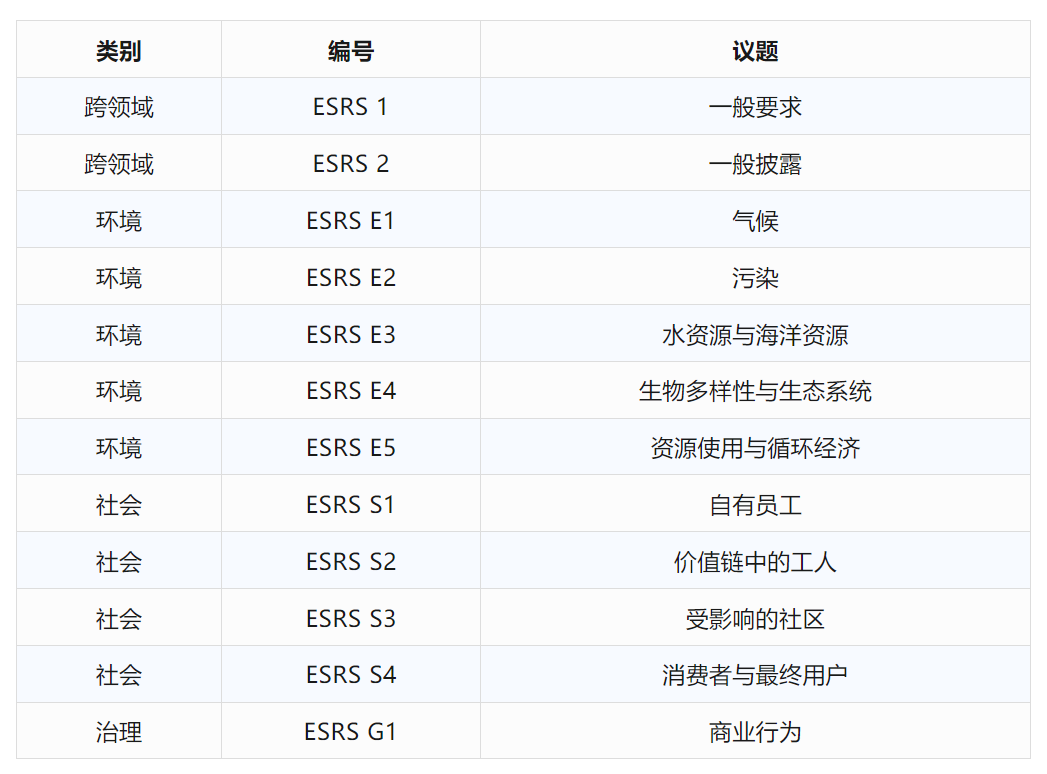
Source: Annex I of the Official Journal of the European Union, European Sustainability Reporting Standards (ESRS)[5]
V. Which Companies Will be Affected by the CSRD?[6]
-
FY 2024: Companies previously subject to the Non-Financial Reporting Directive (NFRD)[7] (large listed companies, large banks and large insurance companies with more than 500 employees), as well as large non-EU listed companies with more than 500 employees, are required to report data for FY 2024 and publish their first sustainability report in 2025.
-
FY 2025: Large companies not currently subject to the NFRD, including other large non-EU listed companies, are required to report data for FY 2025 and publish their first sustainability report in 2026.
-
FY 2026: Listed small and medium-sized enterprises (SMEs), including non-EU listed SMEs, are required to report data for FY 2026 and publish their first sustainability report in 2027. However, they may opt to delay compliance with the reporting requirements by a further two years, starting to report from FY 2028 at the latest and publishing their first sustainability report in 2029.
-
FY 2028: In addition, non-EU companies with annual revenues exceeding €150 million that meet any of the following conditions within the EU are subject to the requirements:
-
Having a branch with annual turnover exceeding €40 million
-
Being a subsidiary of a large company
-
Being a listed SME
-
Such companies will be required to report on their group-level sustainability impacts from FY 2028 onwards and publish their first sustainability report in 2029.
References
[1] EU. Corporate Sustainability Reporting. https://finance.ec.europa.eu/capital-markets-union-and-financial-markets/company-reporting-and-auditing/company-reporting/corporate-sustainability-reporting_en
[2] Official Journal of the European Union. DIRECTIVE (EU) 2022/2464 OF THE EUROPEAN PARLIAMENT AND OF THE COUNCIL. https://eur-lex.europa.eu/legal-content/EN/TXT/?uri=CELEX:32022L2464
[3] EU. Corporate Sustainability Reporting. https://finance.ec.europa.eu/capital-markets-union-and-financial-markets/company-reporting-and-auditing/company-reporting/corporate-sustainability-reporting_en
[4] Official Journal of the European Union. COMMISSION DELEGATED REGULATION (EU) 2023/2772. https://eur-lex.europa.eu/legal-content/en/TXT/?uri=CELEX:32023R2772
[5] Official Journal of the European Union. COMMISSION DELEGATED REGULATION (EU) 2023/2772. https://eur-lex.europa.eu/legal-content/en/TXT/?uri=CELEX:32023R2772
[6] Official Journal of the European Union. DIRECTIVE (EU) 2022/2464 OF THE EUROPEAN PARLIAMENT AND OF THE COUNCIL: Article 5 - Transposition. https://eur-lex.europa.eu/legal-content/EN/TXT/?uri=CELEX:32022L2464
[7] i.e., the Non-Financial Reporting Directive (NFRD). Due to the lack of key information required by investors and stakeholders, it was difficult to compare corporate reports and uncertainties arose regarding their reliability and operability, leading to its replacement by the CSRD.


 HZGF
HZGF