
On 12 June 2025 the “China Climate-Adaptation Finance Opportunities” expert workshop, jointly organised by the World Bank Group’s International Finance Corporation (IFC) and the Huzhou Institute of Green Finance & Sustainable Development (Huzhou Green Finance Institute), was held in Beijing. The event is the flagship industry dialogue under the two institutions’ cooperation on adaptation finance. Regulators, domestic and foreign financial institutions, and research bodies gathered to share emerging good practice, map market opportunities and pinpoint remaining bottlenecks. The ultimate goal is to convert frontier research into policy and deal-flow.
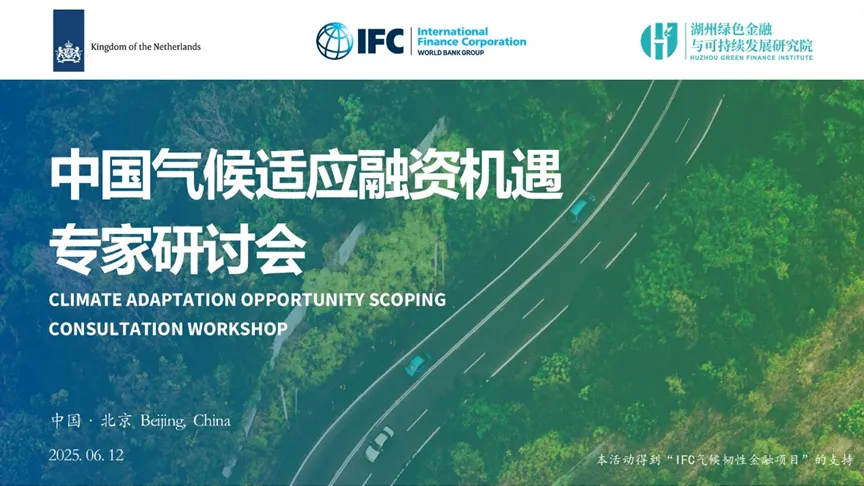
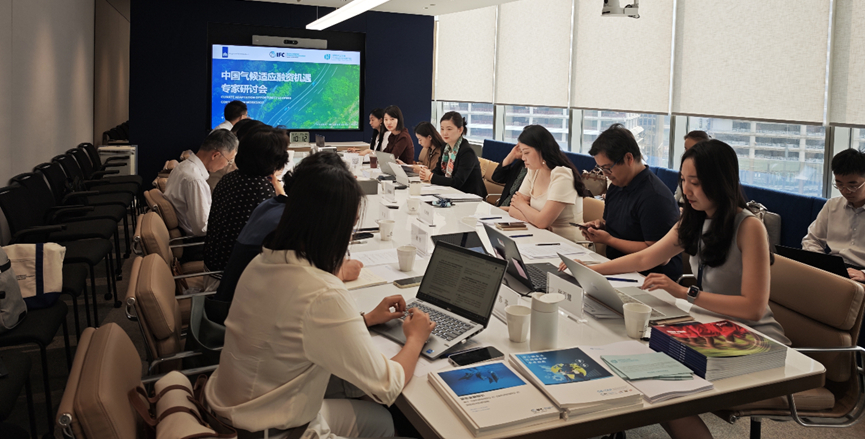
(Meeting photo – courtesy of Huzhou Green Finance Institute)
Ms. Zhu Wenqin – Chief Country Officer, IFC China Office
“Job creation is a strategic priority for the World Bank Group, including IFC,” Zhu noted. “Extreme weather disrupts economic activity and people’s livelihoods. Reducing vulnerability, building resilience and boosting adaptation capacity are essential if we are to keep creating jobs.” She added that scaling investment in these areas will support enterprise growth, local economic development and employment, while injecting momentum into China’s—and the world’s—sustainable-development agenda. “We look forward to working with more partners to design forward-looking, innovative solutions and co-create a greener, more resilient future.”
Ms. Bai Yunwen – President, Huzhou Institute of Green Finance & Sustainable Development; Vice-President, Beijing Institute of Green Finance & Sustainable Development
Bai stressed that climate-related systemic risks are becoming more visible and are now central to economic security, livelihood protection and even financial stability. “Strengthening climate-risk assessment and management and mobilising adaptation finance is a core mission of financial services serving the real economy.” Adaptation and low-carbon transition can reinforce each other, generating combined benefits and spawning new industries and market niches. She recommended starting with in-depth research to produce a clear definition of adaptation finance and an assessment methodology. On that foundation, policy support should be upgraded—issuing directories, arranging incentives and improving fiscal coordination. “For example, we must ensure that the deployment of China’s ultra-long special treasury bonds delivers measurable adaptation benefits.” Capacity-building for financial institutions and corporates, plus active mobilisation of capital and other resources, are equally critical.
Ms. Zhu Yun – Senior Programme Officer, IFC Financial Institutions Group; Head of Sustainable Finance Working Group for East Asia & Pacific
Zhu outlined IFC’s three-pronged approach: (i) build a climate-risk management framework, (ii) nurture an adaptation-finance market, and (iii) develop climate-resilience financial products. Through market-capacity building and pilot programmes, IFC’s China Climate-Resilience Finance initiative is incubating commercial business cases, helping financial institutions customise resilience strategies, upgrade risk-management and investment-identification capabilities, and experiment with insurance innovation.
Ms. Chen Yingjie – Research Director, Huzhou Green Finance Institute
Chen presented the headline findings of the report “China Climate-Adaptation Finance Opportunities”. Chinese socio-economic systems face huge resilience needs, yet corporates and FIs confront three hurdles: difficulty in assessing physical climate risk, identifying adaptation activities, and moving projects from pipeline to proof-of-impact. Internationally, taxonomies of adaptation activities are gradually taking shape, whereas China’s green-finance standards still need to strengthen support for adaptation in high-risk sectors such as industry, energy and transport. Using sectoral and regional profiles, the study produced first-cut estimates of adaptation investment needs and the scope for private-sector participation. Case examples—the Qingdao Bafai seawater-desalination expansion and Bank of Jiangsu’s mine-ecological-restoration project—show that many commercially viable projects generate adaptation benefits and that, with public-sector catalysts, financial instruments can serve multiple sustainable objectives.
The report recommends:
(a) embedding an adaptation lens in China’s green-finance taxonomy, tightening requirements and guidance for FI climate-risk assessment, and piloting innovative risk-sharing and transition mechanisms;
(b) encouraging FIs to conduct physical-risk assessments, run adaptation-focused pilots and invent new business models.
Panel Discussion
Senior officials and market practitioners—Ye Yanfei (former first-level inspector, NFRA), Yang Ping (Director, Research Bureau of the People’s Bank of China), Li Han (Deputy Director, PBoC Jinan Branch), Pan Wei (Executive Director, Head of Product Group, CICC Fixed Income), Fang Yunlong (Secretary-General, Climate Risk Research Center, China Re), Su Yue (Head of North China Sustainable Finance, Standard Chartered), Li Xiaobin (President, Ma’anshan Rural Commercial Bank), Xie Wenhong (China Head, Climate Bonds Initiative), Jiao Jie (VP, Public Benefit Risk Business, Swiss Re China) and Su Ting (Researcher, Sustainable Finance Program, WRI)—shared insights on how to scale the adaptation-finance market.
Policy & Institutional Enablers
-
Open and share climate-related data to break data silos and give FIs more accurate inputs for risk modelling.
-
Finalise adaptation activity definitions and improve operability of standards.
-
Innovate insurance mechanisms, broaden coverage and enhance effectiveness so insurance can play its pivotal role in managing climate risk.
FI & Product Innovation
-
Deploy fintech—AI, big data—to improve efficiency and accuracy of climate-risk identification, assessment and management across the full workflow.
-
Combine policy signals with capacity-building to raise FI and investor awareness and participation, using incentives and market education.
-
Develop science-based risk-pricing that integrates climate factors into FI risk models.
Market Potential
-
The current broad scope of “resilience finance” helps enlarge the addressable market and attract attention.
-
Build a benefit-assessment matrix for different resilience activities and link it to incentive schemes.
-
Deepen cooperation among investors, banks and insurers so that risk-transfer instruments can underpin bank lending and strengthen overall financial-system resilience.
Wrap-up & Next Steps
In her closing remarks Zhu Yun emphasised that adaptation finance is a long-horizon, patient-capital game whose impacts must be measured comprehensively. “Mobilising this kind of finance requires multi-stakeholder consensus, an expert pool and continuous capacity-building.”
The IFC China Climate-Resilience Finance programme sits within IFC’s global climate-risk umbrella. Going forward, IFC and the Huzhou Green Finance Institute will keep working with all partners to deepen practitioners’ understanding of adaptation and resilience, strengthen their ability to identify and manage climate risk, and shepherd more deals from pipeline to market—accelerating the growth of climate-resilient investment in China and beyond.

 HZGF
HZGF